What are we doing for our common home?

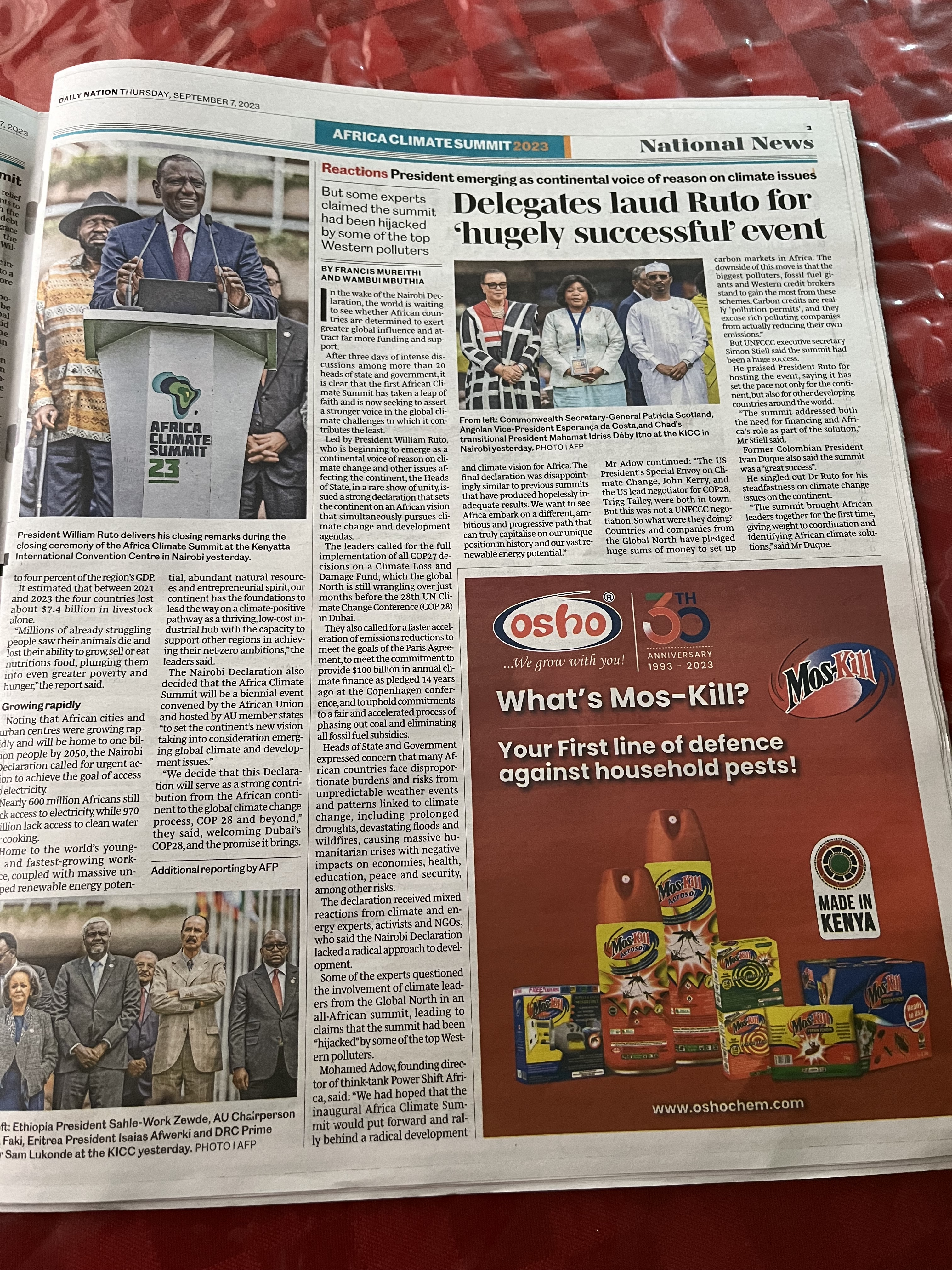
When I first arrived in Nairobi in early September, the three-day Africa Climate Summit was underway. African leaders, along with United Nations Secretary General Antonio Guterres and United States Climate Envoy John Kerry, gathered to discuss the regional reality of climate change in advance of the Conference of the Parties on Climate Change (COP) 28 meeting taking place in Dubai in late November. At the end of the three days, the delegates issued The Nairobi Declaration, a series of actions and commitments to address climate change. Climate funding was the ever-present issue. On-going funding of hundreds of billions of dollars is needed for African states to undertake the necessary investments in renewable energy, adaptation and mitigation efforts. In addition, leaders called for a review of the debt terms of African nations, including a 10-year relief. 

Throughout my month visiting our communities in Kenya and Tanzania, I was struck by the reality that these nations still lack access to basic reliable infrastructure in terms of roads, electricity, and potable water. I have deep admiration for our Sisters who live and work – giving themselves fully – in conditions where they experience power cuts, inaccessible roads during rainy seasons, and where they must expend energy I had never before considered in order to drink a glass of safe drinking water. Their day-to-day living is much harder than I realized. This is their reality. It is a reality I do not experience in Toronto, and I take for granted the ease of my daily life. 

Daily Nation article acknowledged that 600 million Africans lack access to electricity and 970 million lack access to clean water for drinking and cooking. With this reality in mind, I can’t help but think of the work I do in relation to the UN Sustainable Development Goals and the Laudato Si Action Platform, and I am forced to reflect on the burden placed on developing countries in response to the climate crisis. A burden that we who live in developed countries are hesitant to undertake if it means we experience discomfort or inconvenience. 


On October 4th Pope Francis released the apostolic exhortation Laudate Deum on the topic of the climate crisis. Written in follow up to his 2015 encyclical Laudato Si on care for our common home, Laudate Deum is a powerful call to action for world leaders and for each member of the human family. 

Pope Francis critiques efforts to date on climate change. Rather than emission reductions, we are seeing increases. He writes “Yet, with the passage of time, I have realized that our responses have not been adequate, while the world in which we live is collapsing and may be nearing the breaking point.” (2) 

He rebukes those who deny the reality of climate change, those who “would place responsibility on the poor, since they have many children, and even attempted to resolve the problem by mutilating women in less developed countries.” He states, “As usual, it would seem that everything is the fault of the poor. Yet the reality is that a low, richer percentage of the planet contaminates more than the poorest 50% of the total world population, and that per capita emissions of the richer countries are much greater than those of the poorer ones. How can we forget that Africa, home to more than half of the world’s poorest people, is responsible for a minimal portion of historic emissions?” (9) Further on, he reminds us that “everything is connected” and “no one is saved alone.” (19)

If we are not saved alone, then what can we do together? He argues that in order to move from words to action, we need to reflect on human power, its meaning and the limits we place on it. (28) We need to rethink our processes of multilateralism so that they are effective. He refers to the impact of the principle of subsidiarity within multilateral processes – i.e. the impact of NGO movements that can achieve what the United Nations struggles to do – for example, the Ottawa Process to ban the use, production, and manufacture of antipersonnel landmines) (37).

Prophetically, he speaks to world leaders attending COP 28. He calls for that gathering to be relevant and accountable. By focusing on measures such as adaptation, he states that “we risk remaining trapped in the mindset of pasting and papering over cracks, while beneath the surface there is a continuing deterioration to which we continue to contribute. To suppose that all problems in the future will be able to be solved by new technical interventions is a form of homicidal pragmatism, like pushing a snowball down a hill.” (57) He calls for binding forms of energy transition that are efficient, obligatory, and readily monitored. (59)

Pope Francis will make an appearance at COP 28 and deliver an address to world leaders. I am sure his presence will both challenge and inspire. There is still reason to hope that much can be done to address climate change, and address it ways that are just and equitable. Each of us must take seriously the call to action to care for our common home, for ourselves and for our children and their children. Let us all pray for meaningful conversations and real commitment and action in Dubai and in the days and months that follow. 

prophets of peace

rt_pope_911_02_lb_150925_12x5_1600Image source: abcnews.go.com

Like many people, I have been glued to the tv and to online streaming over the past few days to watch Pope Francis’ visit to the U.S. It has been a delight to witness (even from behind a screen) his addresses to Congress and the U.N., and his outreach to the homeless and poverty-stricken in both Washington and New York City. He is inspiring, with his loving yet challenging words, and his authentic presence. To me, he embodies the Jesus that I recognize from the Gospels.

In his whirlwind day in New York City today, he made a stop at the 9/11 memorial to participate in an inter-religious prayer service. I wasn’t able to catch his remarks online but I found the transcript later. His words are deeply moving and are made even more so by the beauty and simplicity of the memorial. I am posting his words here so that I can look back on them later.

******
Interreligious Meeting
Ground Zero Memorial, New York
Friday, 25 September 2015

 Dear Friends,

   I feel many different emotions standing here at Ground Zero, where thousands of lives were taken in a senseless act of destruction. Here grief is palpable. The water we see flowing towards that empty pit reminds us of all those lives which fell prey to those who think that destruction, tearing down, is the only way to settle conflicts. It is the silent cry of those who were victims of a mindset which knows only violence, hatred and revenge. A mindset which can only cause pain, suffering, destruction and tears.

   The flowing water is also a symbol of our tears. Tears at so much devastation and ruin, past and present. This is a place where we shed tears, we weep out of a sense of helplessness in the face of injustice, murder, and the failure to settle conflicts through dialogue. Here we mourn the wrongful and senseless loss of innocent lives because of the inability to find solutions which respect the common good. This flowing water reminds us of yesterday’s tears, but also of all the tears still being shed today.

   A few moments ago I met some of the families of the fallen first responders. Meeting them made me see once again how acts of destruction are never impersonal, abstract or merely material. They always have a face, a concrete story, names. In those family members, we see the face of pain, a pain which still touches us and cries out to heaven.

   At the same time, those family members showed me the other face of this attack, the other face of their grief: the power of love and remembrance. A remembrance that does not leave us empty and withdrawn. The name of so many loved ones are written around the towers’ footprints. We can see them, we can touch them, and we can never forget them.

   Here, amid pain and grief, we also have a palpable sense of the heroic goodness which people are capable of, those hidden reserves of strength from which we can draw. In the depths of pain and suffering, you also witnessed the heights of generosity and service. Hands reached out, lives were given. In a metropolis which might seem impersonal, faceless, lonely, you demonstrated the powerful solidarity born of mutual support, love and self-sacrifice. No one thought about race, nationality, neighborhoods, religion or politics. It was all about solidarity, meeting immediate needs, brotherhood. It was about being brothers and sisters. New York City firemen walked into the crumbling towers, with no concern for their own wellbeing. Many succumbed; their sacrifice enabled great numbers to be saved.

   This place of death became a place of life too, a place of saved lives, a hymn to the triumph of life over the prophets of destruction and death, to goodness over evil, to reconciliation and unity over hatred and division.

   It is a source of great hope that in this place of sorrow and remembrance I can join with leaders representing the many religious traditions which enrich the life of this great city. I trust that our presence together will be a powerful sign of our shared desire to be a force for reconciliation, peace and justice in this community and throughout the world. For all our differences and disagreements, we can live in a world of peace. In opposing every attempt to create a rigid uniformity, we can and must build unity on the basis of our diversity of languages, cultures and religions, and lift our voices against everything which would stand in the way of such unity. Together we are called to say “no” to every attempt to impose uniformity and “yes” to a diversity accepted and reconciled.

   This can only happen if we uproot from our hearts all feelings of hatred, vengeance and resentment. We know that that is only possible as a gift from heaven. Here, in this place of remembrance, I would ask everyone together, each in his or her own way, to spend a moment in silence and prayer. Let us implore from on high the gift of commitment to the cause of peace. Peace in our homes, our families, our schools and our communities. Peace in all those places where war never seems to end. Peace for those faces which have known nothing but pain. Peace throughout this world which God has given us as the home of all and a home for all. Simply PEACE. 

   In this way, the lives of our dear ones will not be lives which will one day be forgotten. Instead, they will be present whenever we strive to be prophets not of tearing down but of building up, prophets of reconciliation, prophets of peace.


Praised be

Creation-image-

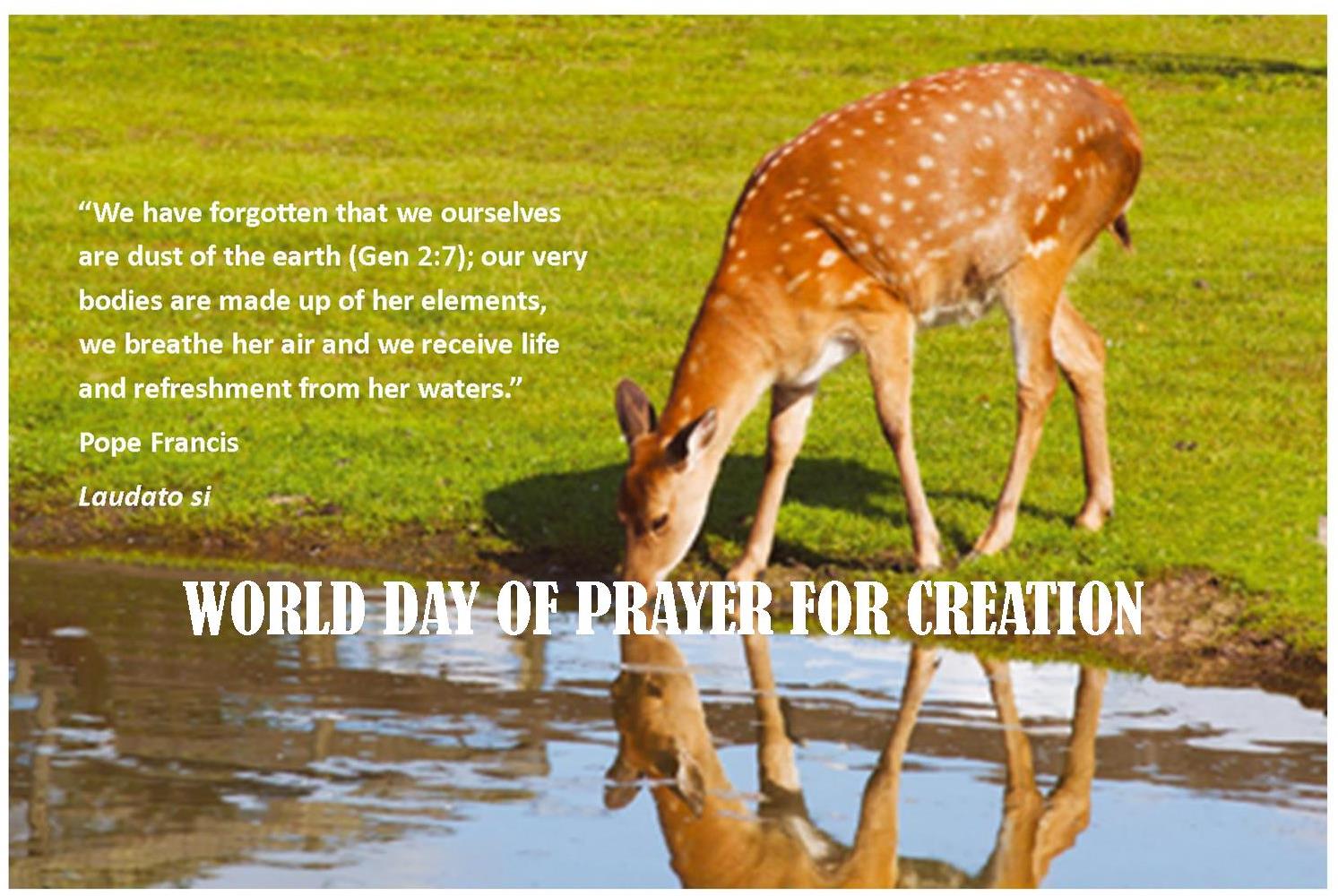
Today is the World Day of Prayer for the Care of Creation. What better way to pray than to pray with St. Francis of Assisi? This poem of his is one of my favourites.

The Canticle of Brother Sun

Most High, all powerful, good Lord,
Yours are the praises, the glory, the honor,
and all blessing.

To You alone, Most High, do they belong,
and no man is worthy to mention Your name.

Be praised, my Lord, through all your creatures,
especially through my lord Brother Sun,
who brings the day; and you give light through him.
And he is beautiful and radiant in all his splendor!
Of you, Most High, he bears the likeness.

Praised be You, my Lord, through Sister Moon
and the stars, in heaven you formed them
clear and precious and beautiful.

Praised be You, my Lord, through Brother Wind,
and through the air, cloudy and serene,
and every kind of weather through which
You give sustenance to Your creatures.

Praised be You, my Lord, through Sister Water,
which is very useful and humble and precious and chaste.

Praised be You, my Lord, through Brother Fire,
through whom you light the night and he is beautiful
and playful and robust and strong.

Praised be You, my Lord, through Sister Mother Earth,
who sustains us and governs us and who produces
varied fruits with colored flowers and herbs.

Praised be You, my Lord,
through those who give pardon for Your love,
and bear infirmity and tribulation.

Blessed are those who endure in peace
for by You, Most High, they shall be crowned.

Praised be You, my Lord,
through our Sister Bodily Death,
from whom no living man can escape.

Woe to those who die in mortal sin.
Blessed are those whom death will
find in Your most holy willl,
for the second death shall do them no harm.

Praise and bless my Lord,
and give Him thanks
and serve Him with great humility.

AMEN

Malcolm Guite

Blog for poet and singer-songwriter Malcolm Guite

Institute of the Blessed Virgin Mary - Canadian Province

Chronicling my formation with the Loretto Sisters (IBVM)

igNation

Chronicling my formation with the Loretto Sisters (IBVM)

ibvm.org

Chronicling my formation with the Loretto Sisters (IBVM)

OLD HEATHER KING

Chronicling my formation with the Loretto Sisters (IBVM)

Book Snob

FOR DISCERNING READERS

Doctor Who Feed

Chronicling my formation with the Loretto Sisters (IBVM)

Quantum Theology

Chronicling my formation with the Loretto Sisters (IBVM)

Ignatian Spirituality

Chronicling my formation with the Loretto Sisters (IBVM)

A Nun's Life

Catholic Sisters and Nuns in Today's World

The Jesuit Post

Young Jesuits seeking God in all things.