

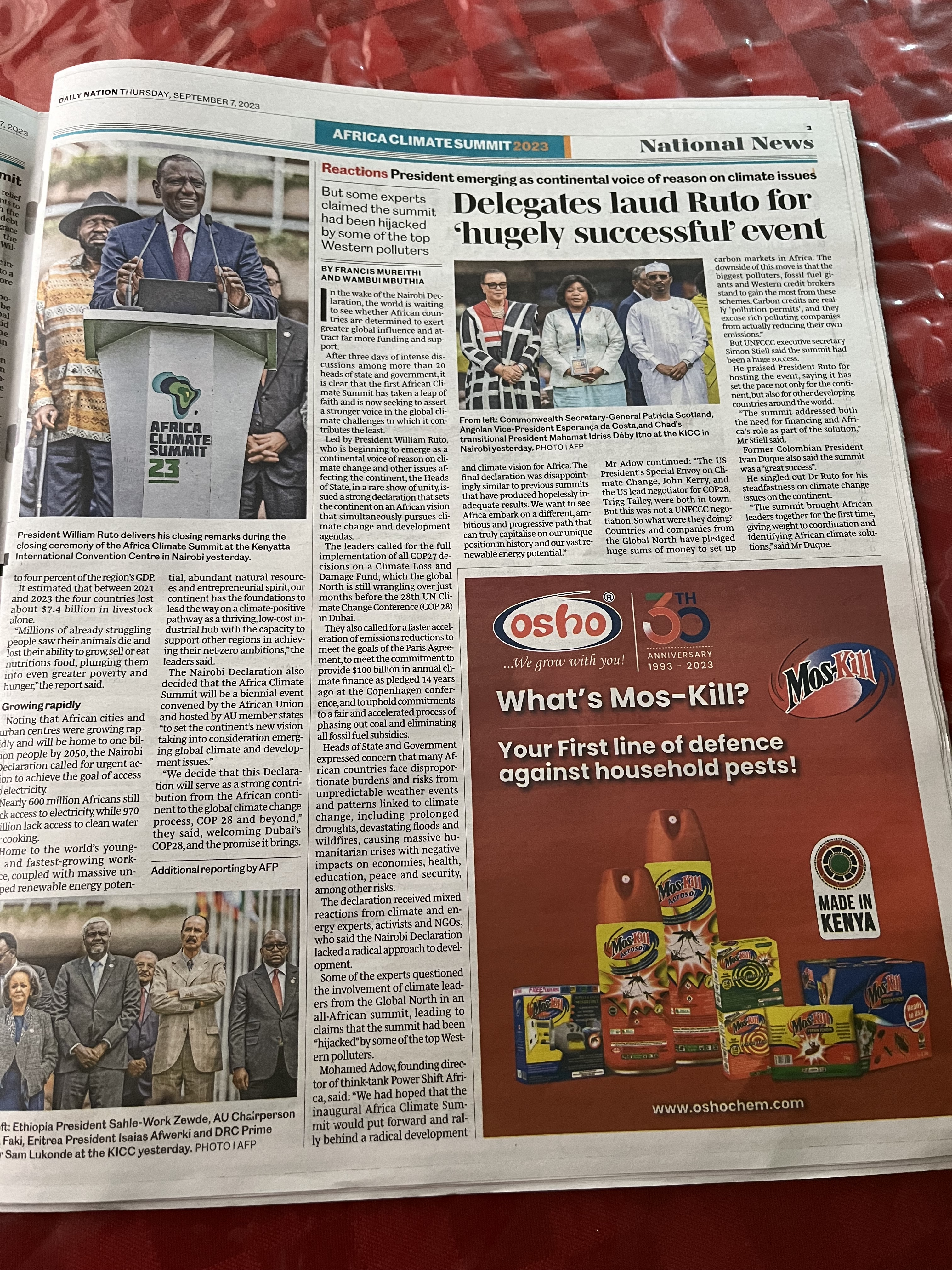
When I first arrived in Nairobi in early September, the three-day Africa Climate Summit was underway. African leaders, along with United Nations Secretary General Antonio Guterres and United States Climate Envoy John Kerry, gathered to discuss the regional reality of climate change in advance of the Conference of the Parties on Climate Change (COP) 28 meeting taking place in Dubai in late November. At the end of the three days, the delegates issued The Nairobi Declaration, a series of actions and commitments to address climate change. Climate funding was the ever-present issue. On-going funding of hundreds of billions of dollars is needed for African states to undertake the necessary investments in renewable energy, adaptation and mitigation efforts. In addition, leaders called for a review of the debt terms of African nations, including a 10-year relief.
Throughout my month visiting our communities in Kenya and Tanzania, I was struck by the reality that these nations still lack access to basic reliable infrastructure in terms of roads, electricity, and potable water. I have deep admiration for our Sisters who live and work – giving themselves fully – in conditions where they experience power cuts, inaccessible roads during rainy seasons, and where they must expend energy I had never before considered in order to drink a glass of safe drinking water. Their day-to-day living is much harder than I realized. This is their reality. It is a reality I do not experience in Toronto, and I take for granted the ease of my daily life.
A Daily Nation article acknowledged that 600 million Africans lack access to electricity and 970 million lack access to clean water for drinking and cooking. With this reality in mind, I can’t help but think of the work I do in relation to the UN Sustainable Development Goals and the Laudato Si Action Platform, and I am forced to reflect on the burden placed on developing countries in response to the climate crisis. A burden that we who live in developed countries are hesitant to undertake if it means we experience discomfort or inconvenience.

On October 4th Pope Francis released the apostolic exhortation Laudate Deum on the topic of the climate crisis. Written in follow up to his 2015 encyclical Laudato Si on care for our common home, Laudate Deum is a powerful call to action for world leaders and for each member of the human family.
Pope Francis critiques efforts to date on climate change. Rather than emission reductions, we are seeing increases. He writes “Yet, with the passage of time, I have realized that our responses have not been adequate, while the world in which we live is collapsing and may be nearing the breaking point.” (2)
He rebukes those who deny the reality of climate change, those who “would place responsibility on the poor, since they have many children, and even attempted to resolve the problem by mutilating women in less developed countries.” He states, “As usual, it would seem that everything is the fault of the poor. Yet the reality is that a low, richer percentage of the planet contaminates more than the poorest 50% of the total world population, and that per capita emissions of the richer countries are much greater than those of the poorer ones. How can we forget that Africa, home to more than half of the world’s poorest people, is responsible for a minimal portion of historic emissions?” (9) Further on, he reminds us that “everything is connected” and “no one is saved alone.” (19)
If we are not saved alone, then what can we do together? He argues that in order to move from words to action, we need to reflect on human power, its meaning and the limits we place on it. (28) We need to rethink our processes of multilateralism so that they are effective. He refers to the impact of the principle of subsidiarity within multilateral processes – i.e. the impact of NGO movements that can achieve what the United Nations struggles to do – for example, the Ottawa Process to ban the use, production, and manufacture of antipersonnel landmines) (37).
Prophetically, he speaks to world leaders attending COP 28. He calls for that gathering to be relevant and accountable. By focusing on measures such as adaptation, he states that “we risk remaining trapped in the mindset of pasting and papering over cracks, while beneath the surface there is a continuing deterioration to which we continue to contribute. To suppose that all problems in the future will be able to be solved by new technical interventions is a form of homicidal pragmatism, like pushing a snowball down a hill.” (57) He calls for binding forms of energy transition that are efficient, obligatory, and readily monitored. (59)
Pope Francis will make an appearance at COP 28 and deliver an address to world leaders. I am sure his presence will both challenge and inspire. There is still reason to hope that much can be done to address climate change, and address it ways that are just and equitable. Each of us must take seriously the call to action to care for our common home, for ourselves and for our children and their children. Let us all pray for meaningful conversations and real commitment and action in Dubai and in the days and months that follow.


 Exploring God’s creation
 Love, the driving force: a journey of discernment