Chastity frees us to move out into the world and to respond with love
I’ve written about chastity before so I won’t go into much detail here. But as I read the Chapter of Renewal notes, I was struck again by the beauty of the vow of chastity and its gift of opening us up to the world.
The motive of Chastity is love of God; the result of Chastity is instense love of neighbour; it is nourished by a spirit of prayer. Our Chastity frees us for deep, personal relationships with one another. Rather than a protective attitude, it engenders a continual growing in love, and a continuing going out to others.
This makes demands on us: openness to the Holy Spirit’s urging; a learning to accept love; mutual acceptance and reciprocal giving. It is God Who first loved us and Who gives us the capacity to love. The test of love is not emotion, but trust and service; ultimately love is a mystery.
As I read through the minutes of the 1967 Chapter of Renewal, I was struck by the concern about vocations, and particularly the shortage of vocations to meet the demands for ministry. It seems to me that the vocation shortage then can’t begin to compare with what we are experiencing now, however, it helped me to see that the decline in vocations has not been sudden but has been in effect for some time. I was struck by the Institute’s reflection on the cause of the decline in vocations and I wonder if it is still applicable today.
There is a need of study into the causes of the present vocation shortage: the unstable culture of the astro-jet age; the widened opportunities in the lay apostolate; and the ‘identity crisis’ in religious life itself.
Might we not be being called now by the Holy Spirit to draw others through the sign of loving community. Perhaps the problem lies with our ‘image’ within the community, where lack of charity weakens mutual trust and forebearance. Today’s young women are especially sensitive to a lack of real community witness to the “Communion of Saints”. At reception, each is accepted as ‘a child of the Institute’. How can this be realized more fully?
Friendships are an important, frankly, essential, part of religious life. Friendship strengthens community and is a source of grace for living out the vows. Allowing deeper friendships within community life was recognized during the period of renewal.
From the 1967 Chapter of Renewal:
Our interpersonal relationships depend upon our experience of love in our houses – there exists great room for ‘shading’ here – and basically on our relationship with Christ.
The young finally professed have special need for our understanding. A beginning might spring from a real awareness that things are different today, that we do not yet have the ‘answer’. Particularly effective is the ‘apostolate of (one’s) presence’, the power of ‘one kind, loving, understanding woman”.
Mother Theresa Dease, founder of the IBVM Canadian Province.
For the past month or so I’ve spent a couple of hours each week reading in our Loretto archives. I’ve long been curious about the modern history of the IBVM in Canada and so for part of my second-year novitiate formation, I am doing a sort of independent study. My interest at the moment is Vatican II and the effects of renewal on the Institute in Canada.
To gain a full appreciation of the changes that took place after Vatican II, I had to start my reading much earlier. I began my reading where our earliest significant documentation has been collected, around 1900, with the records of Chapters (major decision-making gatherings of the Institute). It’s intriguing to read about the monastic customs the Institute had adopted and to see the attention and detail paid to very minute aspects of daily life. It’s definitely not the way of life of the Institute I recognize today.
I’ve since worked my way up through the decades. For the past couple of weeks I have been immersed in the 1960s, fascinated by the Renewal Chapter of 1967 and the follow up Chapter in 1969.
From the documents I have read, mostly preparatory materials and meeting minutes, I get a sense of the excitement of the time. Prior to these Chapters, there was extensive consultation with Institute members. I have scanned through stacks of questionnaires related to community life, prayer, and mission. It’s a fascinating look at the Institute’s response to the Vatican’s suggestion that religious institutes go back to their roots and re-discover themselves through the vision of the founder.
I was amazed by the exhortation I read from a priest advisor to the Chapter encouraging the Sisters to experiment. He urged them to experiment widely – for the next 20 years! – and listen to the Holy Spirit to see where it leads. I am struck by the openness and the bravery of the Sisters to discern beyond what they knew and what they were comfortable with regarding religious life.
There’s so much that I would like to share that it’s too much for a single blog post. So instead I will share a quote or two each day on one aspect of renewal. To begin, here is a selection on the beauty of religious life that I have taken to my prayer.
Religious are to be signs that are not only seen and heard, but which become ‘carriers of a message’ in order to help others to ‘ratify’ their commitment to Christ, to effect a change of heart, of attitude (in Japanese: ‘how your heart lies’)…The sense of person, and growth in deeper love depends upon reverence. Relationship to persons, ‘real community’, ‘to make others joyful’, is the test of Christian maturity.
Yet our witness must be meaningful in this world (not the moon). We have need to render our witness plain, to eliminate whatever blurs that witness. The more natural we are the more supernatural witness we give. Only then does our witness – through the renunciation of the positive personal values involved in the vows, a renunciation fired with love – become a representation of love for God, and the request for return of love in living faith. Our existence partakes of the ‘scandal’ of the Cross which points outside itself to the ‘explosion of divine love’. It is an anticipation of Christian death freely chosen now as a loving decision for God. ‘Normal in any field’ we are nonsense unless Christ is alive, the Lord, now! We are the answer to the ‘death of God’; we witness not only to the existence of God, but His presence of love.
Taken from: Minutes of the 1967 General Chapter of Renewal, June 28 – July 30, First Session, Book 1
“Reading seeks for sweetness of a blessed life, meditation perceives it, prayer asks for it, contemplation tastes it. Reading, as it were, puts food whole into the mouth, meditation chews it and breaks it up, prayer extracts its flavour, contemplation is the sweetness itself which gladdens and refreshes.” – Guigo II, Carthusian Monk
We have begun the practice of weekly Lectio Divina in community. Each Thursday we gather to read the gospel for the coming Sunday. Our practice is simple. We read the text three times, listening carefully and savouring the words.
After the first reading, we pause for a moment and then share a single word or short phrase that captures our attention. After the second reading, we share a bit further, maybe a longer phrase or sentence that moves us. After the third reading, we may feel drawn to offer a brief reflection, maybe relating it to our day or a recent experience. We may end with an intercessory prayer as well or instead. This sacred reading of the gospel text opens me to the Holy Spirit, ready to go where the Spirit leads. Each time of prayer follows the same pattern but always produces newness and variety.
The practice of Lectio Divina is relatively new to me. I practiced it previously in a parish young adults group that I was part of but I have not practiced it consistently. Our current weekly practice took a bit of getting used to at first but I now find it deeply enriching. I appreciate the time for quiet contemplation of the Sunday gospel as well as the sharing that results from our group practice. I am finding that the practice of sacred reading of the gospel text has encouraged me to adopt a practice of “sacred reading” in daily life – looking at the world around me, open to the Spirit, noticing where I am drawn, and seeing all life around me as holy, belonging to God.
*****
I became more interested in the practice of Lectio Divina last year while I was in the Philippines. I’ve mentioned it previously on my blog but I really got hooked on listening to podcasts while I was there. It became a way for me to relax in the evenings and I’ve continued to listen to them since. One of the podcasts I began listening to last year is Harry Potter and the Sacred Text. It’s fantastic! The hosts are graduates of Harvard Divinity School and they treat the much-loved Harry Potter series as a sacred text to be read in a similar way to the Bible, Torah, Koran, etc.
Each podcast episode covers a chapter of a Harry Potter book (they just finished season 2 and the second book in the series – The Chamber of Secrets) through the lens of a particular theme. For example, in the second book, they looked at chapter 16 through the lens of grace and chapter 18 through the lens of love. The podcast is fast-paced and witty and incorporates spiritual practices throughout, including Lectio Divina, imaginative contemplation (yay, Ignatius!), the Jewish practice of Havruta, and each episode ends with a blessing. The podcast is so creative and it encourages the listener to apply these spiritual practices and to see the sacred in the everyday. I can’t wait for season 3!
Five weeks on and I’m getting used to being home. I’m diving into my classes and meeting new people on campus and in the neighbourhood. I’m not quite sending down roots yet but I’m getting to know the soil, preparing to be planted.
So much of what I experienced in the Philippines last year is present with me here in Toronto. I think of my boys at Sarnelli often and of my experience with them, living simply and openly. I desire to live as simply as possible here in Toronto. Over the last couple of weeks I’ve had the opportunity to learn more about what that might look like.
As part of our Institute’s celebration of Mary Ward Week, we participated in a workshop entitled “Living Simply, Living Well”, facilitated by Ann McGowan from the Mary Ward Centre. Ann shared a variety of resources with us and invited us to challenge our understanding of economic growth and wealth. We briefly talked about alternatives to current models of growth and consumption and about investment in things aimed towards the common good (for example, libraries, the arts, etc.).
That discussion continued through my participation last week in a Jesuit Forum discussion group focused on Pope Francis’ encyclical on the care of creation,Laudato Si. Our group had a fascinating and far-ranging discussion about Canadian mining practices, current U.S. politics and recent protests, as well as alternative cultural movements like minimalism and freeganism and freecycling. I went away feeling buoyed by the way the Holy Spirit seems to move through small grassroots movements. When I get discouraged by the seemingly unstoppable societal movement towards excessive consumption and waste, these counter-cultural movements bring me a whole lot of consolation – increases in peace, love, and faith.
I’ve already written about the vow of poverty that I will eventually take, here and here, but poverty and living simply continue to be on my mind. I’ve started volunteering to serve breakfast to the homeless on Saturday mornings and it has increased my desire to not only live simply but to get to know and accompany those who are truly materially and spiritually poor. I feel like God is really pulling me (or pushing me?) in the direction of being with the poor and I am doing my best not to stand in God’s way. I don’t know where this will lead but I trust that consolation will follow. I have a feeling that living simply will be an evolving act of faith.
I’m home now, back in Toronto with the IBVM (Loretto) community in Canada. I’ve been home for 3 weeks now and yet in some ways I still don’t feel like I’m fully home. I’m in a limbo space at the moment, also known as a liminal space – that threshold between the old and the new.
It’s odd that after spending a year in a country that felt so foreign to me for so long, my old, familiar surroundings have taken on that foreign feeling.
Mind you, my life is no longer quite the same as when I left Canada in 2015. I am no longer working at my job in the federal government. I have started part-time theology studies and I am living in a new community of sisters at Loretto College. And I am no longer the same person I was when I began the novitiate. I have been stretched and I have grown in ways that I will become more aware of as I settle back into being home.
In the liminal space there is both comfort and discomfort, both mourning and joyful celebration.
It has been so good to come home, to be back in the familiar. My body, for one, is grateful for it. I could feel my body physically relax as I stepped out of the airport upon my arrival in Toronto and I felt the cool winter air. Home. My body finally feels comfortable again. The dramatic change in temperature from the Philippines winter to the Canadian winter didn’t feel very dramatic to me. It was a relief. I can feel my body operating at a higher capacity than it was able to in the Philippines and I am enjoying that.
Snow! A beautiful sight when I arrived home.
Aside from the physical comfort, there has also been much joy in coming home. I was so happy to reconnect with my beautiful sisters at Loretto Abbey, to hear their stories of the past year, and to share my own with them. I was surprised (shocked, to be honest) to hear that the community followed my blog posts so faithfully and that the sisters were so interested in and attentive to what was happening in our novitiate community (for example, it has been noted that I have not yet written about the vow of obedience! Stay tuned for that…). It was actually very humbling to discover how faithfully the community had been praying for me and the novitiate community.
I have moved from the Abbey now to Loretto College and am getting my bearings here. I have gone from one extreme to another in the course of a year – from the simple living conditions of our novitiate house in Manila to the very generous and comfortable environment of the College, where I am living in a larger institutional setting.
Being welcomed by my new community
I am in school now, too. Navigating two theology courses – scripture and Christology – trying to wrap my mind around new terminology and concepts and opening my mind and heart to new ways of understanding and thinking about God.
In this liminal space, I have not yet fully made the transition from my experience(s) in the Philippines to this familiar yet new environment I am living in and the new mission of studies and ministry I am undertaking.
I find that I miss things about the Philippines more than I thought I would. Of course, I miss my companions a lot (which I had anticipated, and thank goodness for instant messaging and skype to keep us connected!) but I also miss the relaxed culture of the Philippines. I was really struck, especially upon moving to downtown Toronto, by the pace of life at home. People walk quickly, are so focused on getting to their destinations, and are often talking on or looking at their phones. It seems weird to me even though I was very much a part of that lifestyle not so long ago. But now it feels too quick and impersonal.
Another jarring experience has been, or I should say, continues to be, the sight of homeless men sitting on street corners. It makes me feel deeply uneasy. I notice them immediately and I also notice how people pass them by without even glancing at them. After my experience of witnessing poverty in the Philippines, I am really bothered by the sight of poverty in Canada. Poverty is widespread in the Philippines. It’s a very poor country and there is a shocking level of corruption that prevents social issues from being adequately addressed. But Canada is rich. Way richer than I had realized before. And we don’t have the same problems with government corruption. So what the heck is going on in our country that we allow people to live in such poverty and dire conditions?
In this liminal space, on the threshold of the old and the new, I am asking myself many questions. If I have truly experienced the inner transformation that I have claimed to have had last year, how am I going to live differently now that I am home? What am I going to do about injustice? Am I going to listen and respond when my best friend tells me to act?
A little over a week ago I made a return visit to Sarnelli Center for Street Children in Batangas. My fellow novices joined me and I was delighted for them to meet ‘my boys’.
What a happy reunion! My heart danced with joy to be with them again. We arrived in time to have lunch with them and spent the afternoon playing games and sports, reading stories, and watching a movie together. I felt right at home with them again.
When it came time to leave and return to Manila, it was with a much lighter heart that I said goodbye to the boys. I left them knowing that they are forever in my heart but that I will also keep in touch with them by mail and email and I will do whatever I can to assist them from Canada.
I trust that God has brought them into my life to be loved and that God will find ways for me to keep loving them from afar.
Helping with homework at Sarnelli Center for Street Children (Note: for safety reasons I am unable to post photos of the boys’ faces.)
A week ago I returned from a 10-day immersion experience with street children in Lipa, Batangas province. I haven’t been the same since. I have symptoms of withdrawal. I feel fidgety and restless. I check my watch often and I ask myself “What are they doing now?” My heart aches. I really miss my boys.
For 10 days I lived with 8 other novices (5 women, 3 men) and 20 boys aged 9 to 15 years. I would get up with the boys in the mornings and help them get ready for school, eat meals with them, assist them with homework, play with them, pray with them, and care for them like an older sister.
After a couple of days of getting to know them, I began to feel close to them. And then I fell in love with them. Being in love taught me a lot about love.
Praying the Examen for children
Love bridges any cultural or linguistic divide.
I can’t speak Tagalog very well. Or at all, really. At dinner on the first night with the boys, I rattled off the list of Tagalog words I know (basically limited to please and thank you and terms about riding on a jeepney), and made them laugh when I said para po, which means stop, please. They took it upon themselves to beef up my vocabulary and so slowly I learned the words for fork and knife, bowl and cup, rice and fish, and being full (busog). I delighted in learning from them and they delighted in teaching me. I was also schooled in the proper way to use a fork and spoon to eat (do not try to use the spoon as a knife unless you want to be ridiculed!), and I learned to eat rice twice a day (three times proved to be too much), mixing it together with the meat and broth to make a tasty little stew. Each of my successes at mealtimes brought me closer to the boys at my table and was a way for us to show that we cared about each other.
Love gives generously.
I think of all the little ways I gave and received love during those 10 days. I discovered that I can endure discomforts and inconveniences for the sake of love. Lack of sleep, unusual food (i.e. too much rice), and occasional emotional discomfort (being stretched) seemed like nothing because I just wanted to spend time with the boys. I discovered that loving others motivates me to go beyond myself in a way that I find difficult to do when I am focused on myself. For those beautiful boys I felt like I would have done anything.
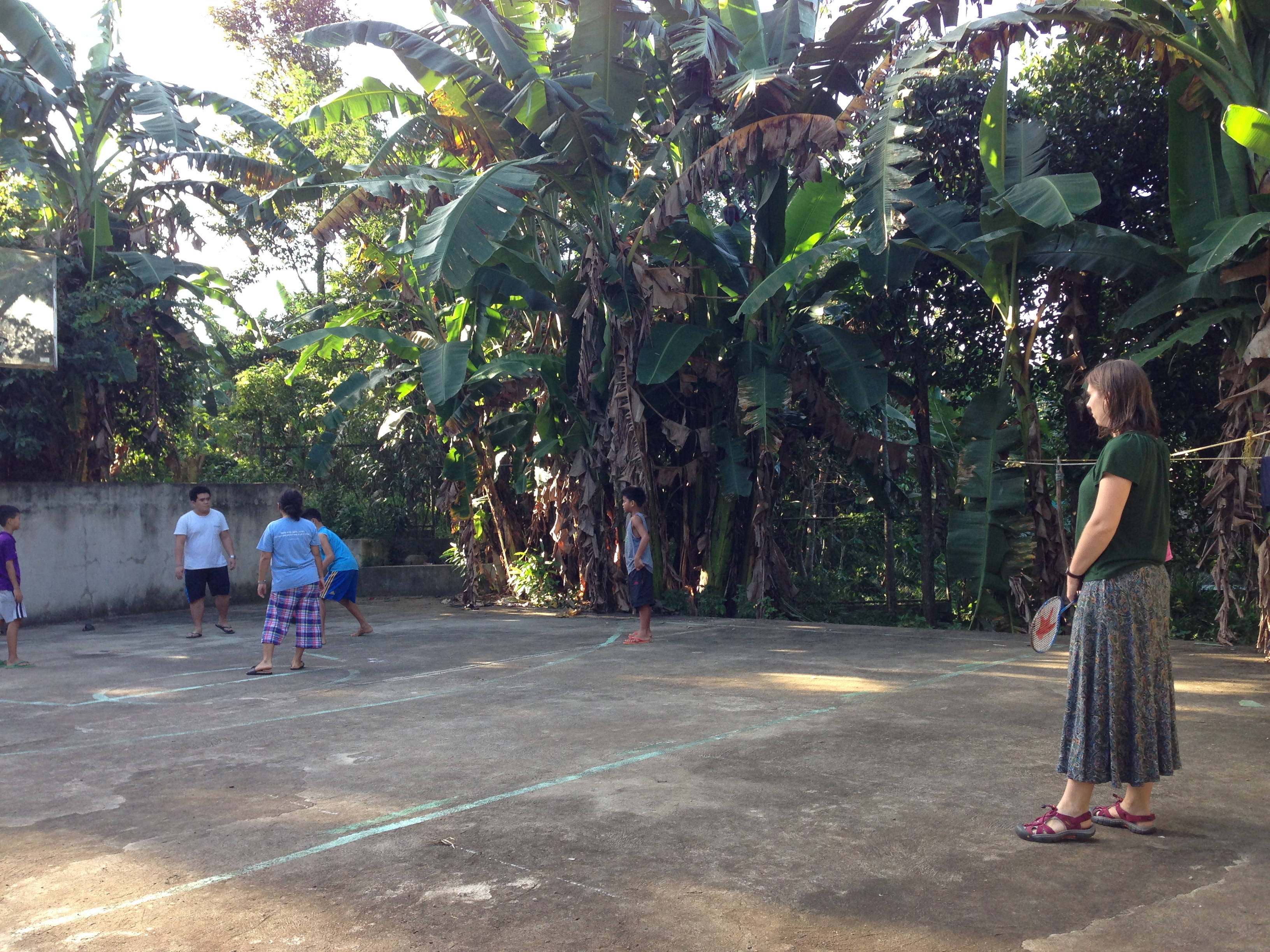
They loved me in their individual ways too. Often it was through material gifts. One boy gave me a little candy or a packet of biscuits every day from his pocket money. He receives only 10 pesos a day to buy a morning snack at school yet he saved a bit of it for me every day. The boys’ love also took the form of playing together after school each day (badminton championships – Canada vs. Philippines!) and reading together every night. At the end of the immersion, I received several little notes and beautiful works of origami expressing their love and appreciation – treasures from the heart.
Getting ready for the next badminton match
Love is not bound by distance.
I was heartbroken when I had to say goodbye to the boys last week. Due to unfortunate circumstances we had a very abrupt goodbye and I am still recovering from the experience. I actually feel pain to be separated from them. But I know that I must continue with my formation and they must continue with their lives too. Even though we are separated now, a piece of my heart will always be with them and a piece of theirs will always be with me. I pray for them and think of them every day and I will continue to do so when I return to Canada. Their love has forever shaped me.
Love is the root of vocation.
During those 10 days, I received significant consolation from God. I felt confirmed in my vocation to religious life and I know that I am called to love those who are neglected or abandoned by society. Throughout my discernment, and at times during this year of formation, I have struggled off and on wondering whether religious life is a selfish way of life. I would think of the job I had in Ottawa and my house and the fact that I could give a child a very good life. I’ve wondered whether I should adopt a child instead and focus my life on giving a child in need a good and loving home. But during the immersion, I really felt a confirmation that God is calling me to religious life and to a freedom to love as many people in need as possible. It does mean that I will not raise a child or devote myself solely to the well-being of one person (or family) but I will be available to love as many people as possible as deeply as I am able.
In the midst of both rejoicing and mourning my experience with the boys, I feel a sense of gratitude for the gift I have been given. And I know that like the 30-day retreat I made in April, the fruits of this experience will only deepen and grow over time.
My group of novices during the immersion experience










 Love, the driving force: a journey of discernment