30 years

Back in the 90s

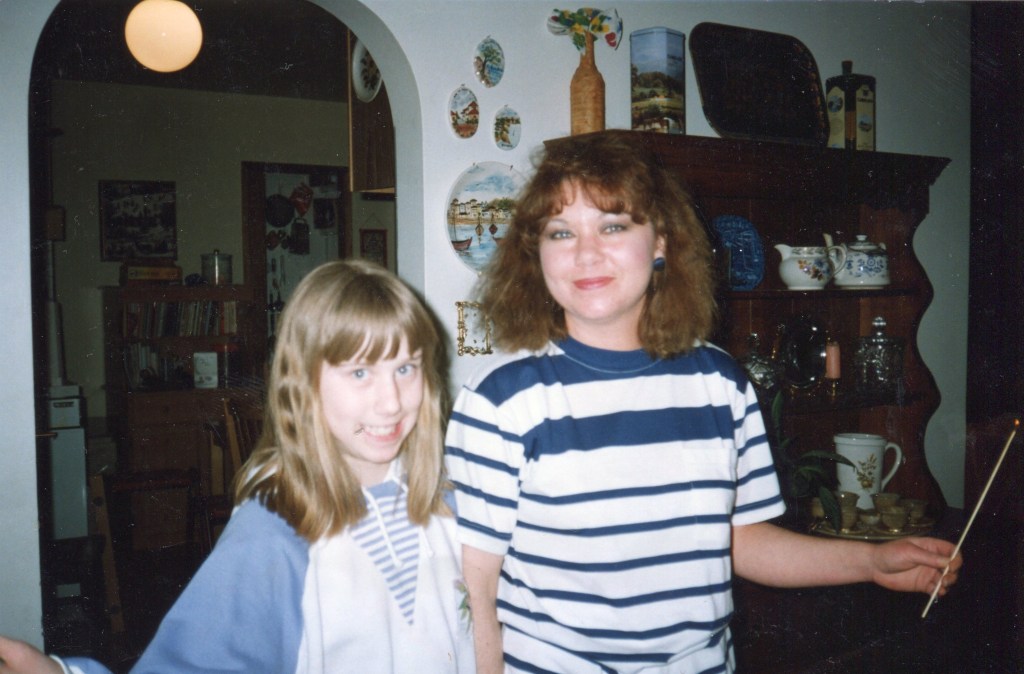
This afternoon as I sat on our rooftop patio, enjoying the afternoon sun, my mind travelled back to 1990, to this day 30 years ago when my mom received a heart transplant. She was 36 years old. 

That day is a bit of a blur now but I remember pieces of it. No doubt each member of my family remembers something different. I was 9 years old and in grade four. The day before she would have her transplant, Mom and I had been at my softball game. Her pager went off. She went to find a payphone to call the hospital to see what the news was. She had been on the transplant list for several months by that time. We were living in Calgary but had spent several months the previous year living in Edmonton in anticipation of her surgery. During that time, her pager had gone off sporadically and she had called the hospital each time only to discover that it was a false alarm. But this time, she came back to tell me that she had to go. There was a heart available and she had to go to Edmonton right away. Being 9, I didn’t really think through the consequences of what she was saying and I told her I would prefer to stay at my softball game until it ended and then meet her back at home. 

I was lucky to see her before she left. When I arrived home a while later, my aunts and two of my mom’s closest friends were there. My aunt Jessica was going to accompany Mom to Edmonton on the plane that had been arranged for them. I arrived just in time to say goodbye to her as they hurried out the door. Mom later said that I had been so calm and brave but I think I was just oblivious because as soon as they left the house, I burst into tears. It wasn’t easy to sleep that night, wondering what was happening to her, waiting to hear news about the surgery. The next morning my brother and I stayed home from school, hoping for an update. When one hadn’t arrived by lunchtime, we both decided it would be better to be busy at school than sitting around at home, waiting. 

I remember sitting in the classroom during the afternoon recess (I was catching up on what I had missed in the morning) when the principal came in (a tall man I found intimidating and a bit scary) to say that he had just received a call from home and that my mom had come through the surgery and was in recovery. I was so relieved. I am sure we celebrated at dinner that night.

But it wasn’t the end of our waiting.

In 1990, organ transplants were fairly new and so recovery was quite different than it is now. Mom had to stay in Edmonton for three months, in the ICU for several weeks and then in an outpatient residence. My brother and I weren’t allowed to visit her while she was in the ICU. I remember the first time we made the trip to Edmonton we had to stand behind a glass partition and wave to her. It was heartbreaking for all of us. The only joy I had was exploring the University of Alberta Hospital with my cousin. We wandered along all of the hallways and discovered the vending machines on each floor, testing them to see if they would randomly yield their delights. Once, we were rewarded with a free root beer. 

In recovery at the University of Alberta Hospital

Finally, Mom was moved to a different floor of the hospital and we were able to go in and hug and kiss her. In a way, it was like meeting a stranger. Her face was puffy and red from the steroids she had to take and she had a long scar that ran from her breastbone down along her abdomen. I was fascinated by it. I think she was self-conscious of it later on because the scar only faded so much, but each time I saw it it made me happy. It was a sign of the new life she had been given, a gift for all of us. 
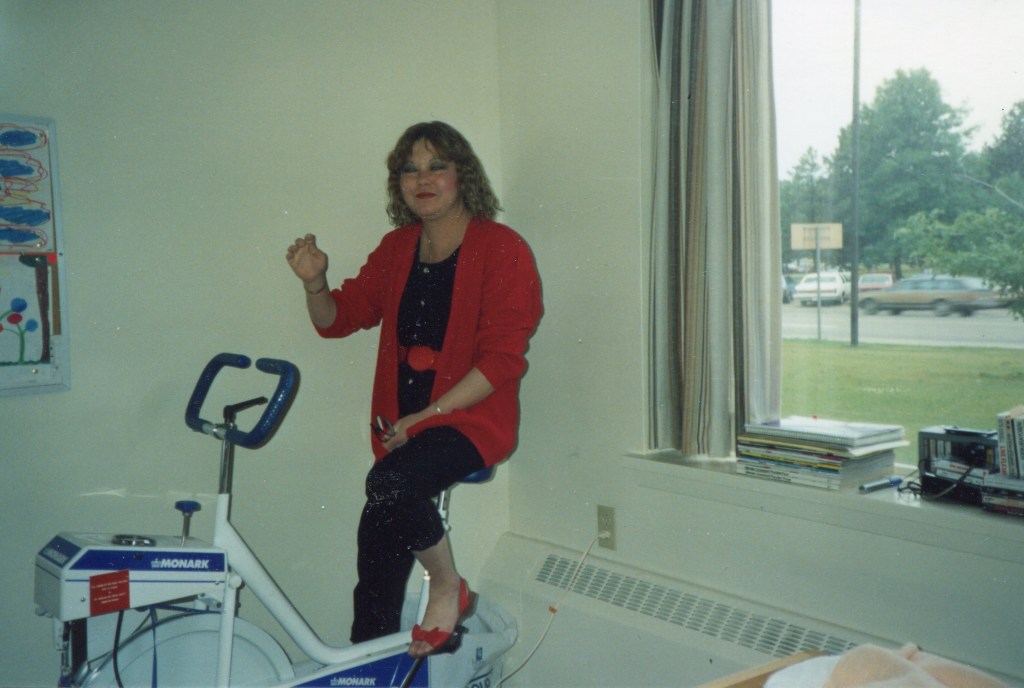
The outpatient residence

Mom eventually came home in August (and saved me from attending a day camp that would have had me riding my bike all over the city – no doubt it would have been good for me but I equated it with torture). It was like having a special guest come to stay. My brother and I were so happy to finally have her home. Each year on May 16th, we would celebrate the anniversary of her heart transplant. I would bring her flowers and it would be like a second Mother’s Day. Every year, even as a kid, I remember being so grateful that someone had offered their organs for transplant so that Mom could keep being my mom.  

At home with the new regime of medication

When she died on May 7, 2003, she was two weeks shy of her 50th birthday, and nine days shy of her 13th heart anniversary. I think of her often during the month of May, sometimes with sorrow on the day of her death, always with gratitude on the day of her heart transplant and with joy on her birthday. Her life, like all lives, unfolded as she did not expect but she met each challenge with courage, generosity, forgiveness, and love. 

Happy 30th anniversary, Mom. 
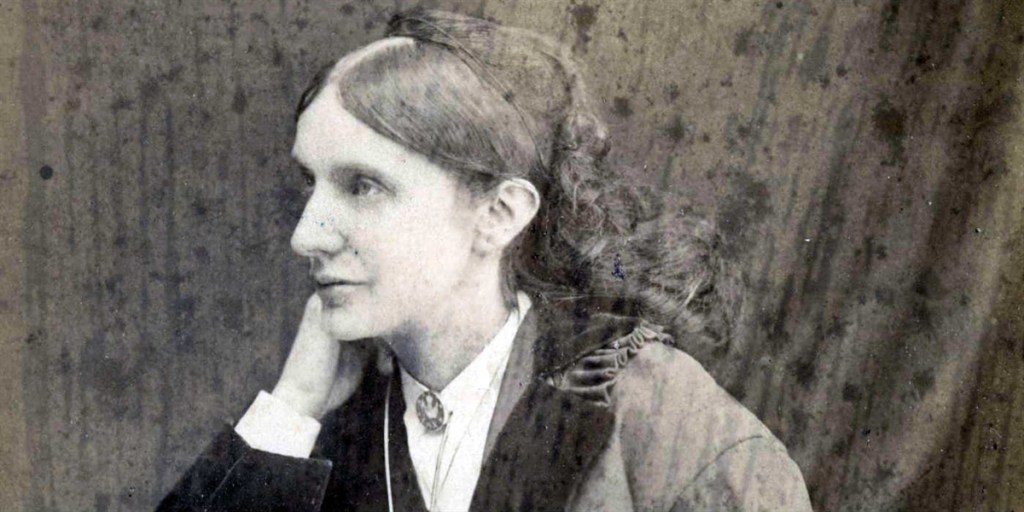
Josephine Butler

Image credit: The London School of Economics and Political Science

I’m working on a research paper for an Old Testament class, exploring the life and exegetical work of Josephine Butler (1828-1906), an Englishwoman and social reformer dedicated to women’s equality. The more that I read about her and by her, the more profoundly I am inspired by her character and her work.

Through her deep faith and prayer life, she grew to personally identify with marginalized women – the poor and destitute, prostitutes and women in prisons and workhouses – and dedicated her life to working for social change that would improve their lives.

I came across a passage in her memoir that beautifully describes her struggle with God as her vocation to advocate for others emerged.

For one long year of darkness the trouble of heart and brain urged me to lay all of this at the door of the God, whose name I had learned was Love. I dreaded Him – I fled from Him – until grace was given me to arrive and wrestle, as Jacob did, with the mysterious Presence, who must either slay or pronounce deliverance. And then the great questioning again went up from earth to heaven, “God! Who art Thou? Where art Thou? Why is it thus with the creatures of Thy hand?” I fought the battle alone, in deep recesses of the beautiful woods and pine forests around our home, or on some lonely hillside, among wild thyme and heather, a silent temple where the only sounds were the plaintive cry of the curlew, or the hum of a summer bee, or the distant bleating of sheep. For hours and days and weeks in these retreats I sought the answer to my soul’s trouble and the solution of its dark questioning. Looking back, it seems to me the end must have been defeat and death had not the Saviour imparted to the child wrestler something of the virtue of His own midnight agony, when in Gethsemane His sweat feel like great drops of blood to the ground.

It was not a speedy or an easy victory. Later the conflict was renewed, as there dawned upon me the realities of those earthly miseries which I had realized only in measure by intuition, but later still came the outward and active conflict, with, thanks be to God, the light and hope and guidance which He never denies to them who seek and ask and knock, and which became for them as ‘an anchor of the soul, sure and steadfast.’

Looking my Liberator in the face, can my friends wonder that I have taken my place, (I took it long ago) – oh! with what infinite contentment! – by the side of her, the ‘woman in the city which was a sinner,’ of whom He, her Liberator and mine, said, as He can also say of me, ‘this woman hath not ceased to kiss my feet.’”

Josephine Butler, Josephine E. Butler: An Autobiographical Memoir

Her passion and commitment to the sufferings of women reminds me, of course, of the passion and commitment of Mary Ward, another strong and faithful Englishwomen. I look forward to continuing my study of Josephine Butler and undoubtedly I will have more to share here.

Learning from the Monks

Credit: The British Library
Copyright: ©The British Library Board

It’s challenging to live under these extended quarantine conditions. Whatever novelty there might have been in the beginning has long since worn off. I continue to be anxious about the state of the world and to pray for the many people who are suffering and for those who care for them and who keep our society running. But I am also experiencing psychological fatigue. One day I am feeling up and the next day I am feeling down.

In the midst of this angst, however, I watched an online retreat/talk given by Fr. Ron Rolheiser, OMI in which he presented principles from his new book Domestic Monastery. I find them particularly apt for this pandemic experience and they are helping me to change my attitude. 

The principles are derived from the Rule of St. Benedict, and lessons from other monks and mystics. For me, they offer an alternative viewpoint that is liberating and helps me to imagine a way to get through this temporary time of forced enclosure. 

Ten Principles for Turning Your Home into a Domestic Monastery

“Regulate your life by the monastic bell”
While I do live in a religious community, we do not live by the monastic bell. We do, however, especially in this pandemic time, have a fairly set schedule of activities – particularly prayer and meal times. My monastic bell is also the schedule I set for myself each day – exercise, work on my theology studies, cooking, connecting with family and friends, etc. It helps to find order and flow in the day. It is also intended to remind me that my time belongs to God and not to me. This helps me to find balance, to set boundaries, and to be able to move freely from one activity to the next.

Stay inside your cell”
Rolheiser suggests that this phrase, for us non-monks, means being faithful to our commitments. To stray away from these things is to leave our cell. For me, this means staying faithful to my religious vocation but also to the commitments I have made that have become more challenging to meet during the pandemic. This includes community life, studies, academic committee work, and ministries that have moved online, as well as finding ways to keep in touch with loved ones and to communicate regularly during this time of distancing. 

“Let your cell teach you everything you need to know”
I find this principle a hard one to live out. Rolheiser says that our fidelity to our commitments will teach us what we need to know. This is a challenge for me. Right now, I feel a lot of resistance and resentment build up because of this forced enclosure. My cell, i.e. school, community, family/friends, ministry, etc. is often teaching me things I’d rather not know – about myself in particular, but also about others, and about the world. Rolheiser says that these things force us to “grow up,” to become more mature, and I suspect, to be more effective agents of God’s love. I take hope that during this pandemic, the moments in which I struggle most with resistance are the moments in which I will be able to experience the greatest transformation.

“Ora” – pray
This is essential. Given my current position of comfort and good health and well-being, committing to prayer is one way that I am able go beyond myself and my environment when it is so easy to stay locked within. Praying for the world – for all who are sick and dying, for all those who care for them, for those who continue to serve our society, for those who struggle with financial insecurity and lack of employment, and for everyone who struggles to cope in this uncertain environment. All of these needs of the world draw me out of my selfishness and my limited perspective and force me to encounter the greater reality of this pandemic. 

“Labora” – work
This principle is all too easy for me. My default setting is to work (at least on the things that I am interested in) and I have been able to find many things to keep occupied during this time. However, work is not meant for work’s sake. Work is meant to remind me of my vocation as a human being to serve God in all that I do. This is something I need to keep calling to mind when I get absorbed in what I am doing and am tempted to forgo other activities in order to keep working on a project.

Live in quiet – be in touch with “the mild”
a. Be in touch with what is gentle inside of yourself, others, the world, God
b. Be in touch with nature
c. Be in touch with your food
Living in the quiet has been both calming and unnerving. To live in a quiet Toronto has been very strange even though it is a necessary measure. Within the confines of my home, this principle speaks to me primarily of being quiet within, of seeking a gentleness of heart in a stressful time that tends to bring out the worst in me. It’s a reminder to be gentle with each person in my life and also with myself. Being open to receive the gentleness of God, especially when I am feeling anxious or overwhelmed. Rolheiser’s sub-points b. and c. remind me to appreciate the natural world around me, especially when I go out for a walk in the neighbourhood, and to appreciate and enjoy the food that I am blessed with each day. 

Understand your family as a “school of charity”
This principle relates to the third principle: “Let your cell teach you everything you need to know.” This experience of the pandemic is a teacher and I am definitely a student. Because this situation seems to frequently bring out the worst in me, I also need to at least try to let it bring out the best in me, too. In his presentation, Rolheiser speaks of a stone being polished by other stones. The little irritations I feel each day, then, if opened up to God’s grace, can polish me as well.

Do “vigils” when the angel of the night summons you
Rolheiser refers to the angel of the night as the grudges, resentments, and unresolved tensions that surface at night and either keep us from sleep or wake us from it. Certainly, these days I feel like the angel of the night is a frequent visitor as I struggle to sleep well. I continue to wake up in the night and to worry about all of the “what ifs” and I battle with the resistances I feel in not being able to live as I would like. It is time to do “vigils” – to confront and find a way to make peace with the angel that disrupts my sleep.

“Celebrate” the joys, particularly the joys of community and simple living – but all the joys of life
This is an important principle for these difficult days. It can be easy to focus on the negative right now and to discount the positive. I know that I struggle to allow myself to really celebrate when so many people are grieving, but I think it is necessary. I resolve to find more opportunities to create, celebrate and embrace moments of joy during this time of confinement – simple pleasures like eating lunch on our rooftop patio, watching the tulips bloom in our front garden, and laughing with family and friends over Zoom. 

“Persevere” – give your family the gift of your fidelity
Perseverance is probably the most necessary guiding principle right now. I must remain faithful to what needs to be done: staying at home, washing hands, and practicing physical distancing, especially when I am tempted to slack off because I am bored, or lonely, or just tired of following rules. Perseverance is assisted by love: being motivated by love for others pushes me to go beyond and do what I might not do solely for myself. 

These principles, while not easy to live by, are helpful to me, especially during this time of uncertainty. They have given me much to reflect on, to change my perspective on what it means to live within restriction, and to find a way to navigate through the doom and gloom that rises in my heart when I am not attentive. There is much wisdom to be learned from these monks.

Malcolm Guite

Blog for poet and singer-songwriter Malcolm Guite

Institute of the Blessed Virgin Mary - Canadian Province

Chronicling my formation with the Loretto Sisters (IBVM)

igNation

Chronicling my formation with the Loretto Sisters (IBVM)

ibvm.org

Chronicling my formation with the Loretto Sisters (IBVM)

OLD HEATHER KING

Chronicling my formation with the Loretto Sisters (IBVM)

Book Snob

FOR DISCERNING READERS

Doctor Who Feed

Chronicling my formation with the Loretto Sisters (IBVM)

Quantum Theology

Chronicling my formation with the Loretto Sisters (IBVM)

Ignatian Spirituality

Chronicling my formation with the Loretto Sisters (IBVM)

A Nun's Life

Catholic Sisters and Nuns in Today's World

The Jesuit Post

Young Jesuits seeking God in all things.